
ABOUT OUR FIRM
How many lawyers does the firm have?
How big is the firm?
Is the firm “aggressive”?
This is one of the most common questions we receive, and it’s an important one. The short answer is: We are as aggressive as we need to be—but no more.
We strongly disagree with a “scorched earth” approach to family law litigation. In our experience, no family is truly served by an expensive and bruising court battle. Unnecessary conflict drains resources, prolongs stress, and can cause lasting damage to family relationships, especially when children are involved.
That said, we are also realists. There are times when one spouse becomes unreasonable or takes untenable positions. Our attorneys have dealt with these scenarios many times, and we know how to respond effectively.
Our approach:
- We counsel our clients not to play games or fight dirty.
- We pursue reasonable resolutions whenever possible.
- We remain firmly prepared to protect your interests when circumstances demand it.
- When aggressive advocacy becomes necessary, we bring the full weight of our experience to bear.
We believe in strategic advocacy over unnecessary conflict—but when your family’s wellbeing is threatened, we stand firm.
How much does your firm charge?
We bill by the hour, with rates that vary based on the attorney. Family law cases are inherently unpredictable—the time and resources required depend heavily on factors often outside our control, such as the cooperation level of the other party, the complexity of assets involved, and whether issues can be resolved through negotiation or require court intervention.
What you can expect:
- A transparent fee structure explained clearly at our initial consultation
- Detailed billing statements so you understand exactly what you’re paying for
- Regular communication about your case status and anticipated costs
- Strategic guidance to help you make cost-effective decisions throughout your case
We are happy to discuss our specific rates and try to estimate a range of potential costs based on your particular circumstances during a consultation. Our goal is to provide excellent representation while being mindful of the financial impact on your family.
Do you offer free consultations?
No, we bill our normal hourly rates for consultation appointments. Here’s why:
A meaningful consultation requires time and expertise. During your initial meeting, we will carefully review your situation, analyze the relevant legal issues, and outline various options.
What to expect at your consultation:
- A comprehensive discussion of your family law matter
- Clear explanations of your legal options and potential outcomes
- Honest assessment of the strengths and challenges of your case
- Transparent information about our fees and what representation would involve
We believe this approach ensures you receive genuine value from our first meeting, whether or not you choose to move forward with our firm.
Where does the firm practice?
The firm practices law in all Northern Virginia jurisdictions, including Fairfax, Arlington, Alexandria, Loudoun, Prince William and surrounding counties. A few of our attorneys are admitted to practice in Maryland and the District of Columbia, although non-Virginia cases are generally referred to lawyers specializing in those jurisdictions.
What is alimony?
Alimony (also called spousal support) is money that one spouse pays to the other during the separation and/or after a divorce to help support them financially.
The basic idea is that when a marriage ends, one spouse may be at an economic disadvantage—perhaps they gave up their career to raise children, supported the other’s education, or simply earned less during the marriage. Alimony helps balance this out so the lower-earning spouse isn’t left in financial hardship.
How does the court determine how much alimony should be paid?
Virginia courts determine spousal support by considering several factors including the incomes and earning capacities of both parties, the duration of the marriage, the standard of living established during the marriage, each party’s age and health condition, contributions by the parties during the marriage (both financial and non-monetary, such as child-rearing), and property distribution.
My spouse committed adultery. Do I still have to pay alimony?
Under Virginia law, adultery can serve as a complete bar to spousal support. However, you must prove the adultery by clear and convincing evidence, which is a high burden of proof. In addition, even if adultery is proven, the court can still award spousal support if denying it would be “manifestly unjust” based on the relative degrees of fault of both parties during the marriage and the economic circumstances of the parties.
Can I request that spousal support be changed if circumstances have changed?
Yes, unless a written Agreement between the parties provides that the spousal support is non-modifiable. Also, the change in circumstances must be “material”.
Does spousal support stop when the recipient spouse remarries?
Yes, unless the agreement between the parties specifically provides that spousal support will continue to be paid even after the remarriage of the recipient spouse.
How is child support calculated in Virginia?
Virginia follows statutory child support guidelines in which the following are factored: both parents’ gross incomes from all sources, number of children requiring support, custody arrangement, work-related childcare costs, health insurance premiums for the children and extraordinary medical expenses not covered by insurance.
If my spouse is denying me visitation, do I still have to pay child support?
Yes, child support and child custody/visitation are distinct and separate legal issues in Virginia. You must continue to pay child support even if the other parent is denying visitation. You should speak with an attorney about your options for addressing the other parent’s actions with regard to visitation.
Does child support stop when my child turns 18?
Not necessarily. If the child for whom support is being paid is still a high school student, living in the home of the parent receiving child support and not self-supporting, child support continues until the child graduates or turns 19 years old, whichever happens first. It is important to note that if child support is being paid for multiple children, the paying parent must return to court to have the child support amount recalculated when one of the children emancipates. The monthly support amount will not automatically change, and the paying parent must continue to pay the full amount until it is formally modified.
Is Virginia a community property state?
No, Virginia is an “equitable distribution” state. This means that marital property is divided fairly, which may not necessarily be equal.
What is marital property in Virginia?
Marital property usually includes assets acquired during the marriage, regardless of whose name is on the title. Marital assets can include, among other things, the family home, vehicles, retirement accounts, cars, and bank or investment accounts. Pets can even be considered marital property!
What is separate property in Virginia?
Separate property generally consists of assets owned before marriage, inheritances, and gifts received by one spouse individually. Separate assets usually remain with the original owner, but these assets can become marital property if commingled with marital assets.
If my spouse and I agree on how to divide our property, do we still have to go to court?
If you and your spouse agree on how to divide your property, you do not have to have a court hearing on property distribution.
How do Virginia courts determine what an equitable distribution of marital property should be?
Virginia courts consider factors like each spouse’s contributions to the marriage (financial and non-financial), the length of the marriage, how and when the property was acquired, and tax consequences associated with the assets.
Who usually gets the house in the divorce?
In determining who gets the house in a divorce, Virginia courts usually consider a number of different factors, such as who has been awarded primary custody of the kids, who has the financial ability to maintain the home, and each spouse’s contributions to the house during the marriage. Generally, the court’s goal is to achieve fairness across the entire marital estate, so the decision about the house is made in relation to how other assets and debts are divided.
Do retirement assets get divided in divorces?
Yes, Virginia courts do divide the marital shares of retirement assets in divorces. Assets that are divided include 401(k) and 403(b) plans, IRAs (traditional and Roth), pension plans, military retirement benefits (both Thrift Savings Plans and pensions), government retirement assets (FERS, Thrift Savings Plan, and other agency-specific pensions), and private pensions.
How are debts divided in divorces in Virginia?
Like assets, debts can be classified as marital, separate, or hybrid. Marital debts are incurred during the marriage for the benefit of the family (e.g., mortgages, car loans, credit cards used for household or family expenses, etc.). Separate debts are usually incurred prior to the marriage (such as student loans) or after the separation. When determining how to apportion marital debt between spouses, the Virginia courts consider, among other things, the purpose for the debt, and how and when the debts were incurred.
What are the grounds for divorce in Virginia?
There are fault-based and no-fault grounds for divorce in Virginia. Fault-based grounds include adultery, cruelty, desertion/abandonment, and felony conviction. No-fault grounds are based on living separate and apart for the requisite period of time (one year if there are minor children, or six months if there are no minor children and the parties have entered into a separation agreement).
Should I file on fault or no-fault grounds?
The decision to file a lawsuit for divorce has far-reaching impacts. A fault-based divorce can be very expensive and filled with animosity. However, there may be valid reasons for filing a fault-based divorce. For example, there is no waiting period to file for divorce on the fault grounds of adultery. Circumstances may require that a fault-based divorce be filed to obtain immediate relief from the court. Only you can make the decision, and only after you have discussed all the ramifications with your lawyer.
How long do I need to live in Virginia before I can file for divorce?
Either you or your spouse must have been an actual bona fide resident of Virginia for at least six months before filing. In short, you need to actually live in Virginia as your permanent home (not just visit or stay temporarily) with the intention of remaining there for at least six months before you can file for divorce. There are specific exceptions for military personnel stationed in Virginia on military orders.
Where do I file for divorce - which court and jurisdiction?
Divorces are filed in the Circuit Court of the county or city where you or your spouse last lived together as a couple or where your spouse lives. If your spouse does not live in Virginia, the divorce action may be filed in the Circuit Court in the county or city where you live.
Does it matter who files for divorce first?
No, filing first does not give an actual legal or procedural advantage in Virginia.
How long do we have to be separated before we can get a divorce?
If you have minor children, you and your spouse must live separately and apart for one year before either of you can file for divorce based on a no-fault ground. If you and your spouse have minor children and you have a signed separation agreement, the separation period is reduced to six months.
Do I have to file for legal separation in Virginia in order to be legally separated?
No, Virginia does not have a procedure for obtaining a formal status of “legally separated.” You can be “separated” in Virginia by living apart from your spouse and maintaining an intent to end the marriage. It is important to note that the date of separation is important not only for starting the requisite separation period, but also for classifying property and debt as marital or separate for purposes of distribution of assets and liabilities.
Can my spouse and I live separately in the same house in order to be separated for the purpose of obtaining a divorce?
Yes, with strict guidelines such as (without limitation) sleeping in separate bedrooms, refraining from romantic relations, socializing separately, etc.
How long does a divorce take in Virginia?
The timeline for getting a divorce in Virginia varies significantly based on your circumstances:
If: | Then the divorce process can take: |
You and your spouse have been separated for 6 months AND there are no minor children of the marriage AND there is a signed Separation Agreement | 60 to 90 days after the matter has been filed in court (which can only occur after the 6-month separation period has passed) |
You and your spouse have been separated for 12 months and there are no issues for the court to determine (such as property division or child custody) | 60 to 90 days after the matter has been filed in court (which can only occur after the 12-month separation period has passed) |
Some or all issues (such as grounds for divorce, child custody, property distribution and/or support) are contested | 24-36 months from separation to divorce |
How should I conduct myself during the divorce process?
Every person reacts to divorce differently and has different ways of dealing with this stressful period. Behavior that may be acceptable from one person in a given divorce may be completely destructive in another situation. However, there are general rules that should govern your conduct:
- If at all possible, try to maintain respectful communication with your spouse and frequent communication if you have children.
- Do not enter into any agreements (especially any agreements that you sign or initial) without first speaking to your lawyer.
- Never threaten or abuse your spouse or children.
- While you can tell your lawyer anything you wish, never say anything to anyone else that you wouldn’t want repeated to your spouse, your spouse’s friends or family, your family, your spouse’s lawyer, or a judge.
- Never destroy records or attempt to hide or secrete assets.
- Bear in mind, especially if you have children, that you will be dealing with your spouse for years to come. Divorce brings an end to your marriage; it does not make your spouse vanish. Reasonable concessions and a respectful attitude during your divorce generally pay untold dividends afterwards.
- Seek professional help in dealing with your divorce. The stress of this process can exact a heavy physical and emotional toll. Most people involved in a divorce would benefit from limited or long-term counseling and a doctor’s care to help them through the divorce.
Can I date if I am not divorced from my spouse yet?
Simply going on a date may be fine, but it is important to understand that adultery (even during separation) is a crime and a ground for divorce in Virginia. Adultery can have significant impacts on your case, as it can bar your request for spousal support or affect your position with regard to custody of the children. The bottom line is that it is important to consult with your family law attorney before deciding to date or enter into a new relationship before your divorce is final.
What types of custody need to be resolved with regard to our children?
Legal custody and physical custody need to be resolved in divorces involving minor children.
Legal custody refers to the right to make important decisions on behalf of a minor child. Parents may share “joint legal custody” or one parent may be awarded “sole legal custody.” Occasionally parents will be awarded joint legal custody, but one parent may be awarded final decision-making authority over particular areas (such as medical or educational decisions).
Physical custody refers to the child’s living arrangements. A parent may have “primary physical custody” (meaning that the child resides primarily with that parent while the other parent has “visitation” or “custodial access”), “sole physical custody” (meaning that one parent has physical custody to the exclusion of the other parent) or “shared physical custody” (meaning that the parents share custody on an approximately equal basis).
What custody arrangements do Virginia courts usually order?
Most of the time, parents may expect the court to award joint legal custody or decision-making authority. There are times when one parent cannot act in a child’s best interests, or when the parents cannot communicate due to a serious problem, such as physical abuse. In such circumstances, sole legal custody may be awarded, but this is uncommon. In terms of physical custody, the arrangements will depend on a variety of factors. It is impossible to predict a physical custody outcome without an extensive examination of factors such as each parent’s historical involvement with the child, future abilities to provide care, and past, present, and future relationships with the other parent.
How old does a child have to be in Virginia before they can choose which parent to live with?
In Virginia, a child cannot make the decision about which parent to live with in a custody case. In the absence of an agreement between the parents, the court always makes the final decision regarding custody for children under the age of 18. In doing so, the judge has to determine the custody arrangement that is in the “best interests of the child.” In determining the best interests of the child, the court is required to consider many factors. One of those factors can be the child’s preference, if the child’s preference is considered to be reasonable in light of the child’s intelligence, understanding, age and experience.
Do mothers always get custody of the kids?
No, mothers don’t always get custody in Virginia. Virginia law is gender-neutral when it comes to custody decisions. Courts are required to base their decisions on what is in the “best interests of the child,” not on the parent’s gender.
Virginia courts consider factors like:
- Each parent’s relationship with the child
- The child’s needs (age, physical and mental condition)
- Each parent’s ability to meet those needs
- The child’s preference (if old enough and mature enough)
- Each parent’s willingness to support the child’s relationship with the other parent
- History of family abuse, if any
Can my custody order be changed later if circumstances change?
Yes, the court will maintain jurisdiction over custody of each child until that child turns 18. A custody order may be modified based on a material change in circumstances occurring since the most recent order was entered, coupled with evidence that the modification would be in the child’s best interests.
Can I move out of state with my child?
This is a critical question with serious legal consequences. The short answer is: it depends on your custody situation. Because there are legal risks associated with moving with your child during or after a divorce, you should talk to your attorney immediately – before making any decisions.
What is mediation?
Mediation is a process in which parties resolve their disputes with the assistance of a third-party neutral (“the mediator”). For family law matters, the mediator is typically an attorney or a retired judge.
The goal of mediation is to reach a fair compromise on all issues and achieve the best post-divorce situation possible for both parties, without the need for costly litigation.
What are the benefits of mediation?
Mediation can:
- Reduce stress on the family
- Allow the parties to determine the outcome of disputed issues rather than being told the outcome by a judge
- Preserve the family’s privacy
- Reduce the overall cost of the divorce
Does Cooper Ginsberg Gray have any mediators?
Yes, we have two mediators: Two of our attorneys (David L. Ginsberg and Nathan J. Olson) are certified mediators in Virginia. They assist parties who have chosen to resolve their family law issues through mediation. In this role, they do not represent either party but instead serve as the third-party neutral with the goal of facilitating a resolution to disputed issues. They also have extensive experience in drafting settlement agreements once such issues are resolved.
What is divorce coaching?
Divorce coaching is a very proactive, solution-focused approach that is geared towards helping you navigate through the difficult hurdles you are likely to experience through the divorce process.
Divorce coaching will help you make informed decisions that directly impact your future. Coaching is not therapy. While therapy focuses on understanding the past and on feelings, coaching is more action oriented in devising plans on how to problem solve and move forward. Essentially, coaching can help you to assess where you are going, how you are going to get there, and how to handle stressful situations as they arise. Relying on your coach’s expertise will keep you on track with your divorce.
Benefits of coaching?
- Getting Results: This is one of the major benefits of coaching. By regularly meeting with your coach and taking the actions needed to meet your goals, you will see more consistent results. Clients often report that they met their goals at a faster pace with a divorce coach than when they were trying to reach them alone.
- Thinking Partner: Your coach will provide you solid emotional guidance that will help you to explore options and develop action plans that are in your best interest.
- Growth Mindset: Your coach will help foster a growth mindset to help you move through stressful situations, as opposed to getting stuck in a rut with fixed mindsets.
- Accountability: Your coach challenges you to follow through on effective action plans, and they will guide you through any hurdles that arise.
- Increased Confidence in Decision Making: Your coach will help you to envision the future. The clearer these next steps look, the more confidence you will experience.
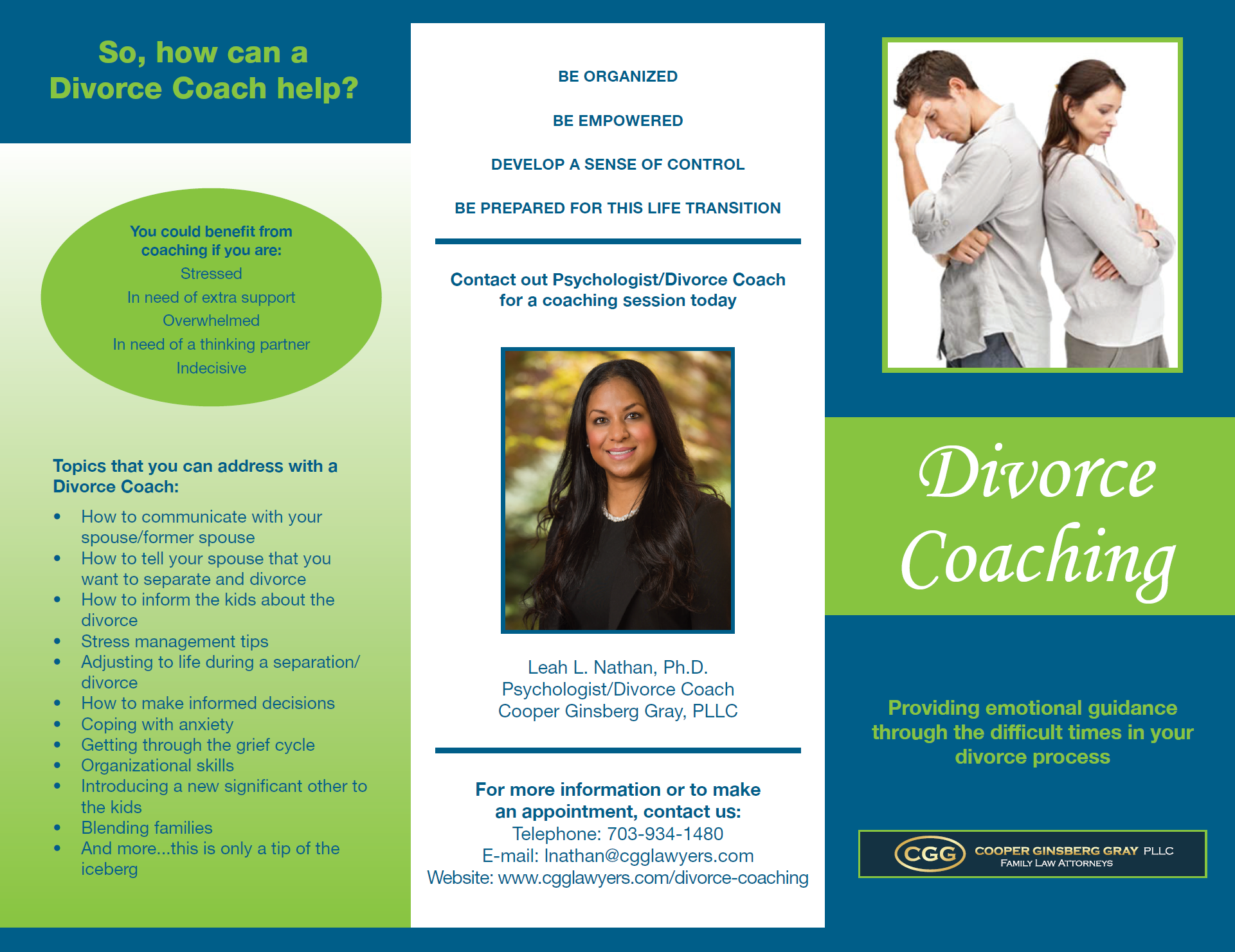
How can a divorce coach help?
- Stressed
- Overwhelmed
- In need of extra support
- Indecisive
- In need of a thinking partner
- How to communicate with your spouse/ex-spouse
- How to tell a spouse that you will be filing a divorce
- How to inform the kids about the divorce
- Stress management tips
- Adjusting to life during a separation/divorce
- How to make informed decisions
- Coping with anxiety
- Getting through the grief cycle
- Organizational skills
- Introducing a new significant other to the kids
- Blending families
- And more…this is only a tip of the iceberg
I had an excellent experience working with Cooper Ginsberg Gray, PLLC. From the very beginning, the team was professional, attentive, and genuinely cared about my situation. They took the time to explain every step of the process in a way that was easy to understand, which gave me a lot of peace of mind. Communication was outstanding; I never felt left in the dark, and they were always quick to respond to my questions. What stood out most was how dedicated they were to achieving the best possible outcome for me. Their knowledge, professionalism, and compassion made a stressful situation so much easier to handle. I’m truly grateful for all their hard work and would highly recommend Alexandria Brumfield to anyone in need of reliable legal support.
One of the best decisions I’ve ever made was retaining Heather Cooper as my family law attorney to represent me for my property settlement agreement and divorce.
Heather took immediate charge of the situation, guiding me through the emotional and difficult process. With her excellent verbal and written communication skills, and astute legal mind, her compassion and dedication to her clients shines brightly.
CGG and in particular Ms. Carly Anderson are compassionate, knowledgeable, experienced legal professionals. Carly was very responsive and gave straightforward advice in a difficult family law matter. I appreciated that CGG respected my time and helped me resolve my issue in a timely, efficient manner. Highly recommend!
Awards & Recognition